
Plogathon Campaign Participants!
After the success of #Sweat4Soap in October 2020, Thirst Foundation had a choice. Wait for the next big UN day, or keep the new community moving. We picked a three-day weekend in December with no official day attached, and asked people to go plogging: jogging and picking up litter.
It was a small campaign with a second job. Three months later, the World Water Run would need to be ten times bigger. The #Plogathon was where we tested what that would take.
The problem
Plastic doesn't feel like a water problem to most people. But 80% of the plastic in the ocean starts on land, and it gets there through drains and rivers. We needed people to make that link.
Mina's campaigns had one engine: a free sign-up that gave you a race number. On #Sweat4Soap, it worked, but the edges showed. The bib "looked like a corporate flyer" and few people printed it. The certificate was an afterthought. Every sign-up still meant an ad click, a website and a form, which is a lot to ask of someone on a cheap phone and expensive data.
The campaign goals
2,000 sign-ups
15 million impressions on #plogathon
a stronger push into South East Asia, and a clear line from litter to water.
test campaign hypotheses before the World Water Run in March the following year
My role
I led the campaign for Thirst Foundation from concept to wrap-up. That covered the strategy, the automated sign-up and race number system, the landing page, all social media, paid ads, the email journey setup from sign-up to thank-you certificate, and daily updates to partners.
I worked remotely from Cape Town with Thirst's team in Australia and a group of freelancers in South Africa.


Changes we tested in this campaign
Redesigned the bib and certificate. I wrote a new design brief and brought in Cape Town designer Marize Engelbreght. We moved from Mina's usual blue to green, and made the bib sporty and playful, closer to the #Run4Rivers one people had liked. The certificate was built into the automation from day one this time: sign up, get your number, plog, get your certificate on Sunday evening.
Built a chat bot for sign-ups. A Facebook Messenger bot filled in name and email from people's profiles. They only had to add their country, and got their bib in about two minutes. That mattered most in the Philippines, India and across Africa, where the form was the biggest drop-off.
Tried volunteer Country Captains. We picked three countries (South Africa, India and the Philippines) and asked local runners with a following to recruit for us.
Tested local faces in ads. Ads with local runners beat ads of Mina by a mile. A local-image ad brought registrations in at about US$0.80 each. An ad of Mina running cost US$7.25 each.
The numbers
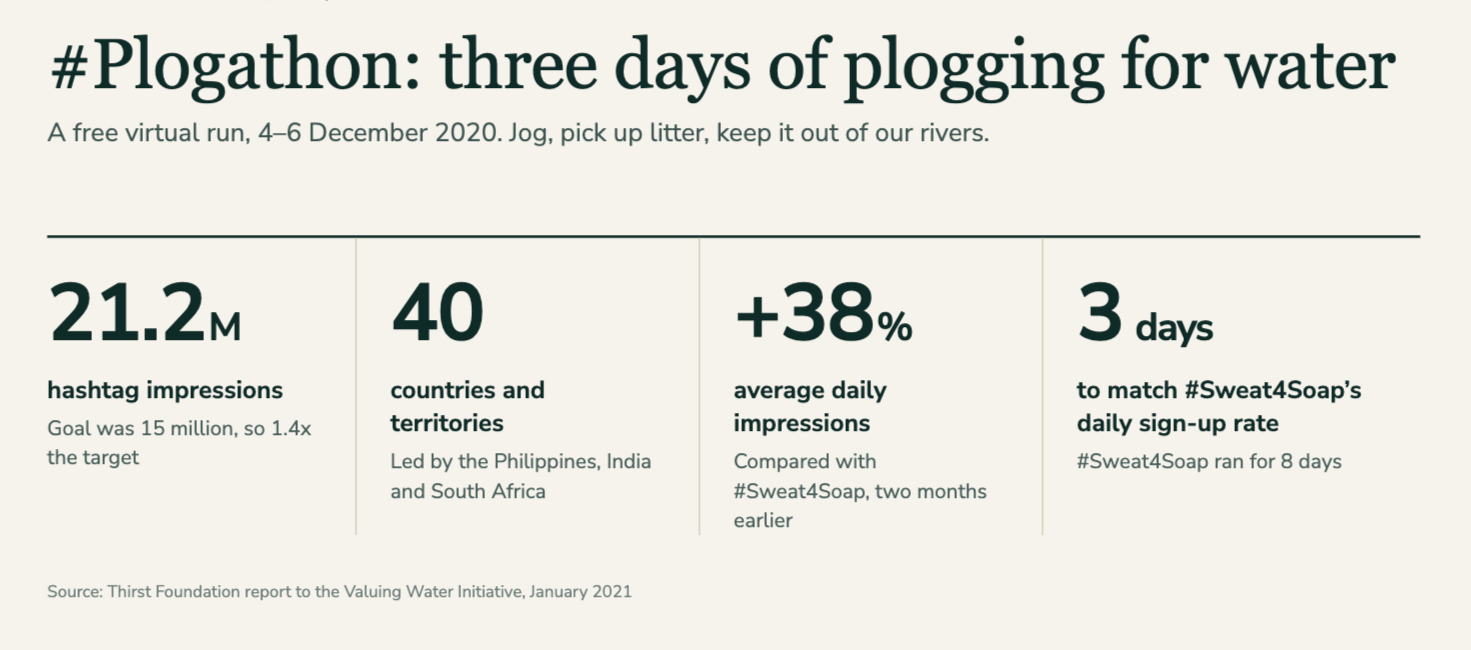
Campaign Insights
The Plogathon didn't hit its sign-up goal. What it did was prove four things that the World Water Run was built on three months later:
Captains work. 3 Country Captains became 18 for the World Water Run, and 144 active captains by 2022.
The bot works. It went straight into the World Water Run sign-up flow.
The certificate is the prize. By the World Water Run, it was "the most asked-after asset" in Thirst's own report. In my report I wrote that people may love it more than the bib.
Local beats famous in ads. The World Water Run's best ad was a local video for India and the Philippines at US$0.52 a sign-up. The Philippines went from 407 plogathon sign-ups to more than 5,000 runners.
The subsequent World Water Run brought in 15,606 unique sign-ups in 132 countries, 2.6 times its target.


