Turning a word-of-mouth coaching business into a clearer, more credible digital brand.

The problem
Flat Rock Endurance didn't have a credibility problem. It had a visibility problem.
Founded by Erin van Eyssen, Flat Rock had grown almost entirely through reputation, referrals and long-term relationships. By 2026, that had created a loyal athlete base and a coaching business with serious depth, but the brand hadn't kept pace. The business had outgrown its original word-of-mouth model, while the endurance coaching market had become increasingly crowded.
The website was the clearest example. The homepage said “Reach your goals” over a photo of a road runner. It didn't show the coaching experience, the community, the coaches' race records or the scale of what Flat Rock had built.
That was a problem because coaching is a trust purchase. Runners are buying much more than just training plan – they're looking for reassurance, structure, judgement, accountability and someone they believe will understand what happens when work gets busy, they miss sessions or race day doesn't go to plan. That became the foundation of the new positioning. Flat Rock Endurnace _ Brand Gui…
The opportunity was particularly clear around Ultra-Trail Cape Town. Flat Rock already had deep knowledge of the race and a strong record of getting athletes to the start line. But none of that was doing much work for the business online.
The strategy
I started with a brand foundation and strategy document for Erin to understand where the brand stood, the market, the positioning, the brand voice and a plan.
Read the market.
Trail and ultra running are growing fast, in South Africa and globally. So is the competition. I mapped local coaching brands, on top of AI training apps like Runna, free Strava and Garmin plans, downloadable programmes and influencers. Flat Rock had grown almost entirely through reputation and referrals, and that model had run its course. Word of mouth was no longer enough. It needed clear positioning.
Start with how people actually buy coaching.
Coaching is a high-trust purchase. A runner is handing over their limited free time, their goal race and often their body. They're buying reassurance, structure, judgement and someone in their corner. The questions they're really asking are: Am I doing enough? Will I be ready? What happens if life gets busy? Before they get in touch, they need to believe three things: these people know what they're doing, I'll belong here, and this is a proper business that will look after me. The old site answered none of those questions.
Build the position on those three beliefs: Authority, community and professionalism, and back every one with social proof.
Each one needed proof, not adjectives.
Authority: the coaching record, media features, and four coaches with more UTCT experience than almost any team in the country.
Community: Wednesday runs from Kloof Corner, Thursday track at Green Point, the Flat Rock WhatsApp community of more than 100 runners.
Professionalism: a clear team structure, a plain explanation of what coaching includes, and a consistent brand identity everywhere.
Social proof: the logos of the races Flat Rock athletes have run, real photos of Flat Rock athletes racing and training, athlete pages and athlete results. A runner should see people like them already doing what they want to do
Give Flat Rock a voice that sounds like Erin.
The running world is full of "no excuses" and "crush your goals". Flat Rock is the opposite: calm, warm, science-backed and kind to the runner. People are hard enough on themselves. The messaging is built on Erin's own words: "humans coaching humans", "the main thing should be the main thing", and the belief that good coaching should help people stay in the sport longer.
Be ready for UTCT.
The phases had a deadline. Ultra-Trail Cape Town is the biggest race on the South African trail calendar, and the training window opens in July. Phases 1 and 2 had to be done by then, so Flat Rock would go into UTCT season ready to make the most of the biggest marketing opportunity of its year, and turn that into coaching sign-ups this year and next.
Decide what not to do.
No lead magnet until there's email infrastructure to support it. No paid ads, because coaching is a considered purchase and organic authority does the work better (and budget limitations).
Do it in the right order.
The plan had four phases, built on one principle: don't light the fireworks before building the bonfire. Brand is the foundation. Revenue is the outcome that depends on everything underneath it.
Phase 1: Brand. Decide what Flat Rock is and isn't, write the coaching philosophy, find the voice. This becomes the guiding principle for every decision after this (website copy, social posts, service descriptions).
Phase 2: Platform. Fix the leaks and make the brand consistent everywhere a prospect might land. Marketing into a broken funnel wastes attention and money.
Phase 3: Marketing. Put the brand in front of the right people, consistently, in ways Erin can actually sustain.
Phase 4Revenue. Grow beyond 1:1 coaching, but only once the first three phases are in place. Done too early, new products look like a cash grab. Done at the right time, they're a natural extension of the coaching relationship.
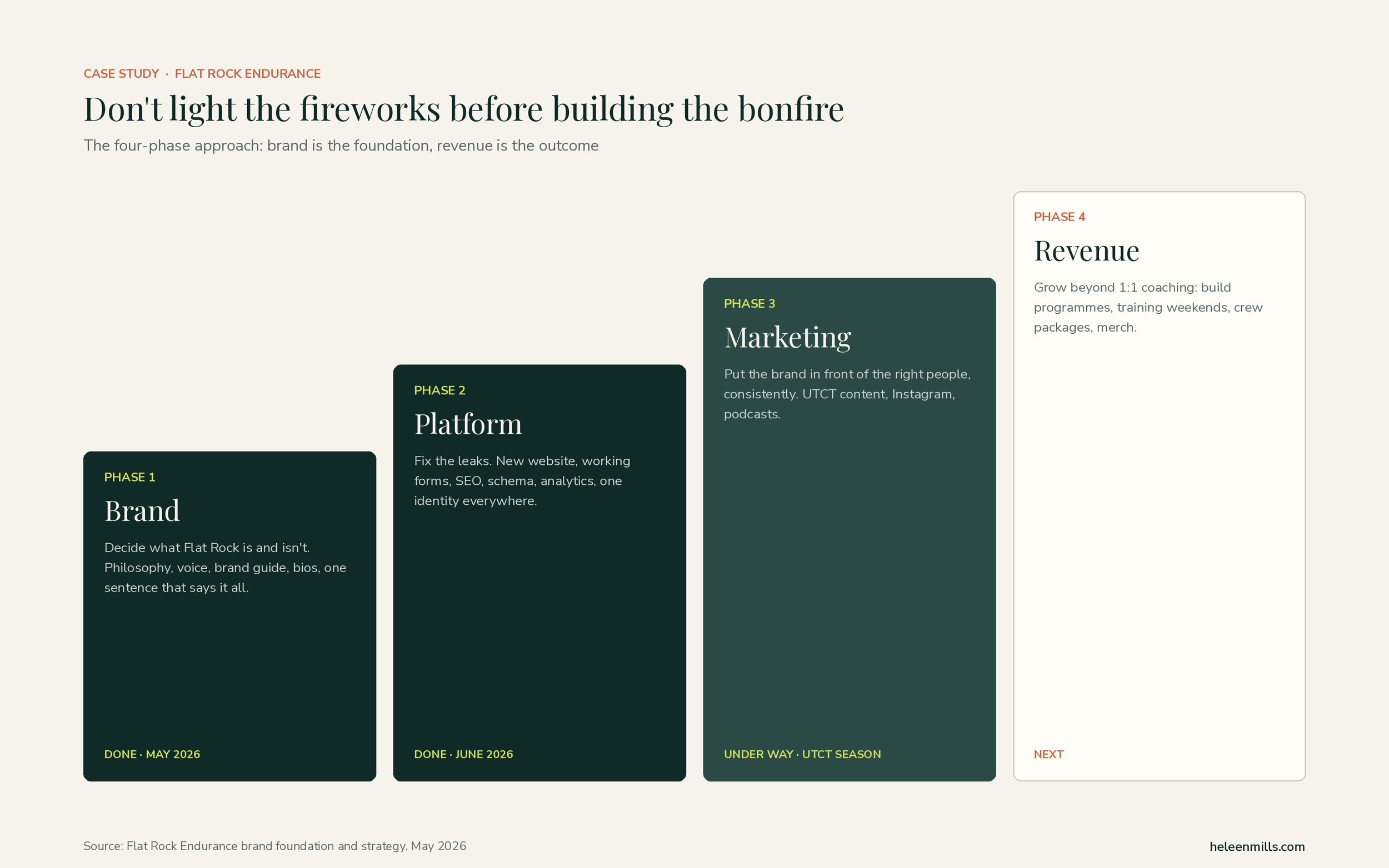
What I did phase by phase
PHASE 1: BRAND
A brand foundation and brand guide covering what Flat Rock is and isn't, who its athletes are, its coaching philosophy ("coach the human first", "training should support life, not consume it", "consistency matters more than perfection"), its voice, and logo, colour and type rules. Updated coach bios, and a single sentence Flat Rock uses to describe itself.
PHASE 2: PLATFORM
The new website went live in June before the UTCT training window opened in July.
A refreshed homepage that answers “Who are you? Can you get me to my race? Who will coach me? What do I get? What does it cost? How do I start?”
A coaching team page where every coach has a role, a specialism, a country and
An athlete results page.
A media page with Erin's Runner's World feature and podcast episodes.
A contact page that tells people exactly what happens next: a reply within 48 hours and a 30-minute call.
SEO from the ground up so that search engines and AI understands who and what Flat Rock is
Measurement before marketing.
Installed GA4 and Google Search Console.
Built a Looker Studio dashboard, so Erin can see what's working
One identity everywhere. Social bios and visuals aligned across the website, Instagram and Facebook, so Flat Rock looks and sounds the same wherever a runner finds it.
PHASE 3: MARKETING
A UTCT plan to make Flat Rock the UTCT coaching team in Cape Town. It includes flatrockendurance.com/utct, UTCT crewing, group long runs and more.
Consistency on social media re posting and engagement
PHASE 4: REVENUE
With the foundations in place, the next step is revenue.
Before and after: the website


The numbers
2026 already has more enquiries than any year since at least 2023, with almost three months to go. For three years the contact form converted about 8 or 9 in every 100 people who saw it. Since the relaunch, it converts 15. Nothing about the form changed. What changed is that people now arrive at it already convinced.
Visits are also up 32% on last year, and four of the five months since launch beat every month in the three years before.

Search is starting to work too. Since June, Flat Rock shows up in Google more than three times as often each week, and clicks have doubled.

Next steps for Flat Rock Endurance
Flat Rock went into UTCT season ready. September, deep into UTCT training, was its best month in at least three years for both website visits and enquiries.
The website is now doing some of the work that previously happened in DMs. A runner who has never heard of Erin can land on the site, see where Flat Rock athletes have raced, meet the coaches, understand the coaching philosophy, see what coaching includes and what it costs, and book a call. More of them are doing exactly that.
The team also has things it didn't have before: a clear position it can repeat across channels, a voice that sounds like its head coach, a dedicated UTCT page that can be used year after year, and a dashboard that shows what is working.
We've also had some useful feedback directly from new athletes. In onboarding calls, runners have told Erin that the website and digital presence gave them a much better sense of the coaching philosophy and the people behind Flat Rock. It helped remove some of the uncertainty around choosing a coach. Importantly, it felt authentic and real rather than boastful. Form conversion is now at an all-time high.
What's next
The next challenge is consistency.
Flat Rock needs a marketing cadence the team can actually sustain; much like training for an ultra. There is little value in going out too hard in the first 20 kilometres and dropping out later. The same applies to marketing. The goal now is to build a steady rhythm of content, race coverage, community activity and search-focused content that can keep working long after UTCT season is over.
The next phase is also to start building out the revenue layer of the strategy. That could mean merchandise, race-specific training programmes, training weekends or other services that add value for existing athletes while creating more accessible ways for new runners to enter the Flat Rock ecosystem.
The foundation is now there. The focus shifts from getting the basics right to building something that can keep growing.